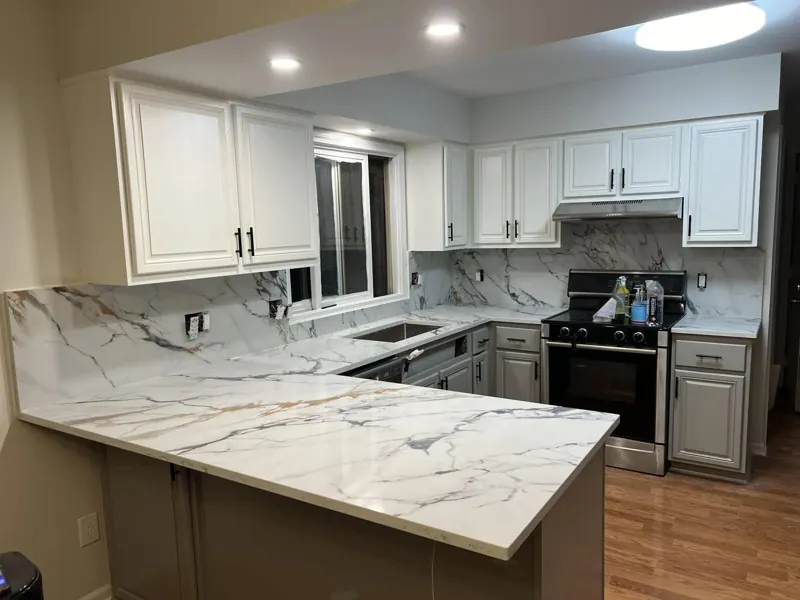

A marble slab countertop is one large piece of natural stone, cut and shaped to fit your kitchen or bathroom. It gives you a classic look, and it asks for a little care in return. We are Stone Proz, an owner-operated shop in Roseville, and this is how we explain the job to a homeowner who has never hired a fabricator.
TL;DR
- Marble is a natural stone. It looks beautiful, but it scratches, etches (dulls) and stains more easily than granite or quartzite, so it suits people who accept some wear.
- Carrara, Calacatta and Statuary are the common white marbles. They behave the same way. The difference is the veining and how rare the stone is.
- A honed (matte) finish hides etching better than a polished (shiny) one.
- Marble needs sealing, careful cleaners and trivets under hot pans.
- Your price comes from our free in-home measure and one written quote. Most installs take 1 to 2 days once the stone is fabricated.
Table of Contents
- What is a marble slab countertop?
- Is marble a good choice for a kitchen countertop?
- Which marble should I pick: Carrara, Calacatta or Statuary?
- Should I choose a polished or honed finish?
- How do scratches, stains and heat affect marble?
- How do I seal and clean marble?
- How much do marble slab countertops cost?
- What happens when you hire us for a marble countertop?
- Do you work in my area?
- Is marble right for a bathroom vanity top?
- Which stone fits how you cook and live?
- Ready to see marble in your kitchen?
- FAQ
- Sources
What is a marble slab countertop?
It is a countertop cut from a full slab of marble, a large flat piece of stone that comes from a quarry. A fabricator (the shop that cuts and finishes the stone) shapes the slab to your layout. That includes the edge profile, the sink cutout and any faucet holes.
Because the stone is cut from a slab, the veining runs across the surface the way nature laid it down. No two slabs are the same. That is a big part of why people choose marble.
We fabricate and install granite, quartz, quartzite and marble countertops for kitchens and bathroom vanity tops. You can see our marble countertop page for the full picture of what we do with this stone.
Is marble a good choice for a kitchen countertop?
Yes, if you like the look and you are comfortable with a surface that changes over time. Consumer Reports describes marble as beautiful and classic. It also says marble chips and scratches easily and has to be sealed periodically to protect against staining.
The same guide says small nicks and scratches can often be polished out. In its tests, most stains on sealed marble wiped away with water. That is the practical case for sealing.
Marble also stays naturally cool. Forbes Home points out that this makes it a great surface for baking and rolling dough. If you bake, that matters.
Here is the honest way to think about it. Over the years a polished marble counter picks up light dulling and the odd mark. Some owners love that lived-in look, the way old European kitchen counters look. Others do not. Decide which kind of person you are before you order, and you will be happy with the result.
Which marble should I pick: Carrara, Calacatta or Statuary?
Pick the one whose veining you like. These three white marbles behave the same way. Remodelista quotes a stone industry expert who says there is really no difference between them in porosity (how much liquid the stone soaks up).
What does differ is the look and the supply:
| Marble | Typical look | What to know |
|---|---|---|
| Carrara | Soft gray veining on a white to gray ground | Quarried in larger amounts, so it is usually the more modest choice |
| Calacatta | Bold, dramatic veining on bright white | Rarer, so it is priced higher |
| Statuary | Strong gray veining on a very white ground | Also rarer, so it is priced higher |
The same Remodelista piece explains that the price gap between them comes down to supply and demand. It is not a difference in how the stone performs.
You may also see marble in other colors, such as dark and green stones. Darker marbles can show water spots and residue more than white ones. Bring the idea to your consult and we can talk it through.
Should I choose a polished or honed finish?
If you cook a lot, ask about honed. A honed finish is matte, with no shine. A polished finish is glossy.
Etching is the dull spot that acid leaves behind, from lemon juice, tomato sauce or wine. On a shiny surface the dull spot stands out. On a matte surface it blends in. Forbes Home notes that etching can be hidden by honing, and that is why many homeowners with busy kitchens choose it.

Honing does not replace sealing. Stains are a separate problem from etching, and sealing is what protects against them.
Bold veining also hides small marks better than a plain white surface. If you want a lower-maintenance look, a honed finish with busy veining is a sensible pairing.
How do scratches, stains and heat affect marble?
Marble is softer than granite, so it scratches more easily. This Old House states that marble is more porous and softer than granite. That makes it more prone to staining and etching from acidic substances.
Here is what that means in daily use:
- Scratches: Do not cut on the stone. Use a board. Light scratches can be buffed out, and Forbes Home mentions dry #0000 steel wool for light scratches and water spots.
- Etching: Wipe up lemon juice, vinegar, wine and tomato sauce quickly.
- Stains: Oil, coffee and wine can soak in if the stone is not sealed.
- Chips: Edges are the usual weak point. Rounded edges tend to hold up better than sharp square ones.
- Heat: Forbes Home cautions that marble is not completely heat resistant. Put hot pots and pans on a trivet, not straight on the stone.
Good Housekeeping gives the same advice: use trivets under heavy pots and pans, because marble chips and scratches easily.
These are normal habits for a natural stone counter. Once they become routine, you stop thinking about them.
How do I seal and clean marble?
Seal it after it is installed, then reseal on a schedule. Good Housekeeping recommends treating marble at least once a year with a food-grade penetrating sealer. A penetrating sealer soaks into the stone instead of sitting on top.
A simple water test tells you when it is time. Drop a little water on the counter. If it soaks in and darkens the stone, reseal. If it beads up, the sealer is still working.
For daily cleaning, use a soft cloth with warm water and a mild, stone-safe soap. Keep these away from marble:
- Vinegar and lemon juice
- Bathroom, grout and tub cleaners that contain acid
- Abrasive powders and scouring cleaners
Consumer Reports found that hard-water deposit removers left a permanent mark, even on sealed stone. Read the label before any product touches your marble.
If you are cleaning the whole kitchen before sealing, a professional deep cleaning for kitchens can take care of the surfaces around the counters. Keep the stone itself on the gentle routine above.
Sealing and these care rules apply to natural stone: marble, granite and quartzite. We go over the care routine with you for the stone you choose.
How much do marble slab countertops cost?
The price depends on your job, so we do not post numbers. We give you one written price after the free in-home measure. You will find marble prices online that range very widely, and they will not match your kitchen.
Here is what moves the price on a real job:
- The marble variety. Rarer stones with dramatic veining cost more than common ones, as the Remodelista piece explains.
- The size and layout. More surface and more seams (joins between pieces) mean more work.
- The edge profile. A simple edge is quicker than a detailed one.
- Cutouts. Sink, faucet and cooktop openings are cut to fit your fixtures.
- Tear-out. If we remove your old countertops, that is part of the job we plan for.
When we give you the quote, you get one written price that covers the job we agreed on. That lets you compare it to your budget before you decide.
What happens when you hire us for a marble countertop?
It starts with a call, not a sales visit. Here is the process:
- Free phone consult. You tell us about the room and the look you want. We answer your questions about marble.
- Free in-home measure. John, who owns Stone Proz and has more than 20 years installing stone, measures every job himself. This is templating, which means measuring to make a cutting pattern for the stone.
- One written price. After the measure you get the written quote. The price comes from that visit, not from a guess over the phone.
- Fabrication. The stone is cut and finished to your pattern, with the edge and cutouts you chose.
- Installation. Most installs take 1 to 2 days once the stone is fabricated. John is on site for the install.
If you are replacing old counters, we handle the tear-out of the old countertops as part of the work. Our countertop replacement page explains how that works. For a closer look at the day itself, read our guide to what happens during stone countertop installation.
You can also look through our work to see the kind of projects we take on.
Do you work in my area?
We work out of one shop at 19024 Florida St, Roseville, MI 48066. We serve Roseville and nearby Macomb County cities, plus Harper Woods and the Grosse Pointes.
If you are in one of these towns, we have a page for marble in your area:
- Marble countertops in Roseville
- Marble countertops in Warren
- Marble countertops in Sterling Heights
- Marble countertops in Macomb Township
- Marble countertops in Mount Clemens
- Marble countertops in Eastpointe
Is marble right for a bathroom vanity top?
Often it is a very good fit. A vanity top does not see hot pans or a cutting board, and it is a smaller surface. That makes marble’s weak points less of an issue.

Watch the products you keep by the sink. Acidic cleaners, some toothpaste and cosmetics can mark an unsealed surface. A sealed top with a gentle cleaner holds up well. See our bathroom vanity tops page for what we build.
Which stone fits how you cook and live?
Marble is one of four stones we fabricate. If you love the look of marble and are ready for the care, it is a good answer. If you want a similar light, veined look with a harder surface, ask us about quartzite. Our guide to custom quartzite countertops explains how it works.
Granite and quartz are the other two choices. Natural stone like granite and quartzite follows sealing rules. Quartz is engineered, and it follows the manufacturer’s specifications instead. Read about granite or quartzite on their own pages.
For a kitchen, start at our kitchen countertops page. More articles are in our countertop blog.
Ready to see marble in your kitchen?
We fabricate and install marble countertops for homeowners in Metro Detroit. Every job starts with a free phone consult and a free in-home measure, followed by one written price. John is the one who measures, and he is on site for the install.
If you are thinking about marble, look at our marble countertops page. Then call (586) 718-8092 or request a free estimate.
FAQ
Is marble a good kitchen countertop?
It can be, if you accept that it will scratch and etch more than granite. Consumer Reports calls it beautiful and classic, and says sealing protects it against stains. A honed finish and trivets make daily life easier.
Do marble countertops need to be sealed?
Yes. Good Housekeeping recommends a food-grade penetrating sealer at least once a year. Reseal when a drop of water soaks into the surface instead of beading.
Can I put hot pans on marble?
No, use a trivet. Forbes Home notes that marble is not completely heat resistant. A trivet also protects the surface from scratches from heavy pan bottoms.
How long does a marble countertop install take?
Most installs take 1 to 2 days once the stone is fabricated. John is on site for the install. We go over the steps with you at the free phone consult.
Sources
- Consumer Reports: Best Countertop Buying Guide
- Forbes Home: Marble Countertop Pros and Cons
- Remodelista: The Difference Between Carrara, Calacatta, and Statuary
- This Old House: All About Stone Countertops
- Good Housekeeping: Best Countertop Materials for Kitchens