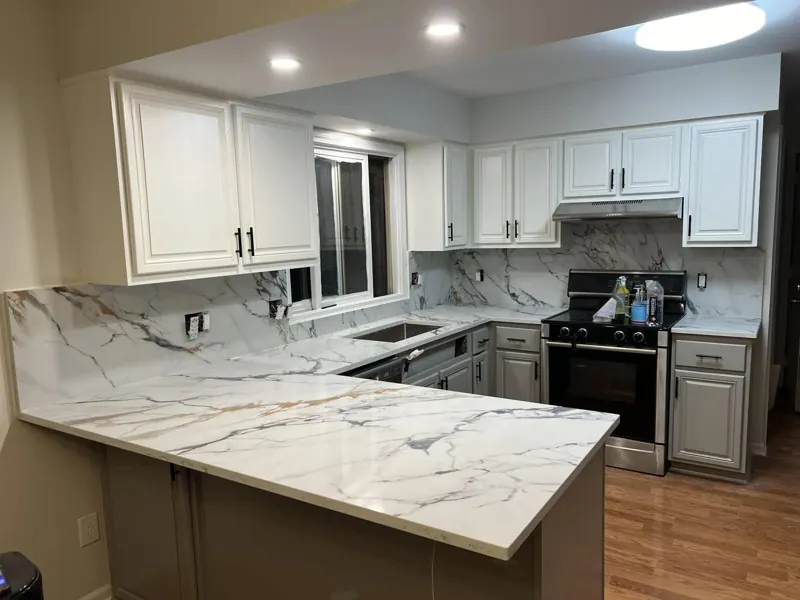

Yes, you will see a seam in quartz, but a well-planned one reads as a thin, tight line and not a flaw. Most kitchens need at least one, and where it goes matters more than whether it exists.
We are Stone Proz, an owner-operated shop at 19024 Florida St, Roseville, MI 48066. John, our owner, has more than 20 years installing stone and measures every job himself. This guide is for Metro Detroit homeowners who have never hired a fabricator (the shop that cuts and installs the stone) and want to know what a seam is, where it should sit and what to expect.
TL;DR
- A seam is the joint where two pieces of countertop meet. Longer runs and L-shaped layouts usually need one.
- You will see a seam up close. Dark and solid colors hide it best, while light or heavily veined quartz shows it more.
- Placement follows the layout, the sink and the stove, and it is set at the measure, before any stone is cut.
- Seams on a finished top are not a do-it-yourself fix. Call a fabricator.
- Your price comes from our free in-home measure and one written quote.
Table of Contents
- Why does a quartz countertop have seams at all?
- Should you be able to see seams in quartz countertops?
- Do color and pattern change how much a seam shows?
- Where should seams go on a quartz countertop?
- How do fabricators make a seam look better?
- What should you ask a fabricator about seams before you sign?
- Can you fix a quartz countertop seam you don’t like?
- Do other stones handle seams the same way?
- What does Stone Proz do for kitchen and bathroom countertops?
- FAQ
- Ready to talk about your layout?
- Sources
Why does a quartz countertop have seams at all?
Because slabs come in a fixed size and kitchens do not. When your counters run longer than one slab, or turn a corner, the top has to be made in two or more pieces and joined.
Quartz is an engineered stone. It is made in a factory from crushed quartz and resin, then cut into slabs. The slab is the raw sheet we cut your countertop from. A kitchen with a long wall, an L-shape or a U-shape often needs more stone than one slab can give.
One home-improvement guide, Hunker, notes that a counter longer than 120 inches may have to be built in more than one section, which creates a seam. That is a rule of thumb, not a law. Your layout decides.
Seams also show up for practical reasons. A very large piece is hard to carry through a doorway, around a tight turn or down a basement stair. Splitting it makes the job safe to handle and keeps the stone from cracking on the way in.
The trade association pamphlet from the Countertop Guild training materials says seams are common in every countertop material. Quartz is not special here. Granite, marble and quartzite tops get them too.

Should you be able to see seams in quartz countertops?
Yes, you can see them if you look for them. The goal is a seam that is tight, flat and hard to notice from standing height, not one that disappears.
The same training pamphlet says most materials will show visible seams unless the stone has directional veining that can be lined up. Quartz that is a single flat color has nothing to line up, so the joint is the only thing you notice.
Three things decide how much you see:
- How tight the joint is. A narrow, clean joint reads as a hairline. A wide or uneven one catches the eye and a fingernail.
- How flat the two pieces sit. If one edge sits higher than the other, you feel it when you wipe the counter. Fabricators call that height difference lippage (one piece sitting higher than its neighbor).
- How well the color and pattern match across the joint. Pieces cut from the same slab, in the right order, match far better than pieces from different slabs.
For how wide a quartz seam may be, the quartz maker’s own fabrication specs are the rule. Quartz is engineered, so it follows the manufacturer’s specifications, and we work to those. Natural stone has its own standards, which is a different conversation. We keep the two apart on purpose.
Do color and pattern change how much a seam shows?
Yes. Color is the biggest factor you control, and you control it when you pick the slab.
According to Hunker’s quartz seam guide, seams are less visible on dark-toned quartz and more noticeable on light-toned or variegated quartz. Variegated means the color changes across the slab, with swirls, flecks or veins.
Here is how that plays out in a kitchen:
- Solid and fine-speckled colors hide a seam well. The eye has no pattern to follow, so a thin joint blends in.
- Dark colors tend to look uniform, which helps. Dust and light reflections can still outline a joint, so a clean, tight fit matters.
- Light colors with bold veining are the hardest. A vein that jumps at the joint draws the eye to it.
This is the question we hear most from first-time buyers: “Can the seam be invisible?” Not entirely. A better question is where the eye lands first. If the seam sits in a spot that nobody looks at, and the pattern runs across it gracefully, most guests will never find it.
If you are still choosing a color, look at our quartz countertops page and see finished work on our project gallery. Look at where the joins fall in the photos.
Where should seams go on a quartz countertop?
Seams belong where the top is well supported, away from the spots that take the most stress, and out of the main line of sight. The layout decides the final spot.
A seam is the weakest line in a countertop, so we place it with care. Industry practice, as laid out in Stonify’s guide to seam placement, recommends:
- Seams over solid support, within about 3 inches on each side of the joint.
- Seams at least 6 inches from the edge of a cutout, such as a sink or cooktop opening.
- Seams out of the main sightline where the layout allows.
The same guide says no U.S. building code regulates where countertop seams go. Placement comes from fabricator practice, the stone maker’s installation guide and your contract. That is why it pays to ask about it before you sign.
Why not put a seam at the sink?
A sink cutout removes a large piece of stone and leaves narrow strips on either side. Those strips are the most fragile parts of any countertop. Put a joint right beside them and you stack risk on risk. Keeping the seam away from the opening is the standard approach.
There is a layout reason too. Water sits near the sink and the joint is a line where grime can collect. A seam in a dry stretch of counter is easier to live with.
What about the stove and the dishwasher?
Quartz makers publish rules for these areas and they differ by brand. Some tell fabricators to keep seams away from the dishwasher and the cooktop. We follow the maker’s specification for the slab you choose, because that spec also governs the warranty on the stone.
How does a corner or L-shape work?
An L-shaped run is the classic case for a seam. There are two common ways to build it. One is a joint in the corner itself, where two straight pieces meet. The other is a joint a short way along one leg, so the corner is a single piece of stone. Which one is right depends on your slab size, the veining and how the room is built.

This is also why the measure matters. John measures every job himself. He can see the walls, the sink position and the real corners of your room, and that is where the seam conversation belongs.
How do fabricators make a seam look better?
By cutting the pieces cleanly, matching the pattern and filling the joint with a matching adhesive. Each of these happens in the shop and on installation day, and none of it is a homeowner task.
A seam has four parts that decide how it looks:
- Planning the cut. The pieces are laid out on the slab so the pattern flows from one to the next. This is why pieces from the same slab match better than pieces from separate slabs.
- Templating. This means measuring your room to make a cutting pattern. A good template gives you edges that meet with no gap.
- The adhesive. Seams are bonded with a color-matched adhesive. Makers of quartz publish instructions on how installers should match and apply it.
- The set. The two pieces are pressed together and checked for height, so that your hand slides across without catching.
The final step depends on the room. A countertop only sits flat if what is under it is flat. Our installers check this on the day, and the 1 to 2 day install window covers it.
We do not recommend trying any of this yourself. Cutting, bonding and setting stone takes shop tools and practice, and a mistake cannot be undone. If you want to know what happens on install day, our step-by-step stone countertop installation guide walks through it.
What should you ask a fabricator about seams before you sign?
Ask where each seam will go, why it goes there and how many there will be. A fabricator who has measured your room can answer all three.
Bring these questions to your estimate:
- How many seams will my layout need? A straight run under one slab length may need none. An L or U shape usually needs one or two.
- Where will they fall? Ask to point to the spot on your actual counter.
- Which slab, or slabs, will the pieces come from? Matching improves when pieces come from the same slab.
- Will the veining run across the joint? Important for light, patterned colors.
- Is any seam near the sink, cooktop or dishwasher? The answer should be no, or you should hear the reason.
- Is the seam placement in the written quote? Know what you are agreeing to.
At Stone Proz, every job starts with a free phone consult and a free in-home measure, followed by one written price. We do not quote a figure over the phone, because the price comes from the in-home measure and the written quote. The measure is also where the seam layout gets sorted out, with John in your room.
Can you fix a quartz countertop seam you don’t like?
Sometimes a seam can be improved, and a fabricator is the right person to judge. A visible seam on a finished top is not a weekend project.
Seams that bother people usually fall into three groups:
- The joint is a little wide or has a visible gap. A fabricator can look at the filler and the fit.
- One side sits higher than the other. This is the lippage described above. You can feel it with a fingertip.
- The pattern or color does not line up. This is a matching problem from the slab layout, and it is the hardest to change on an installed top.
If you have a seam you are unhappy with, call us and describe it. We will tell you what is realistic. When the problem is the layout itself, a new top can be the cleanest answer, and that is part of our countertop replacement service, including tear-out of the old countertop.
Please do not sand, polish or grind the joint yourself. Quartz makers do not recommend machining a seam to improve its look, and you can scratch the surface around it.
Do other stones handle seams the same way?
Not exactly. Granite, quartzite and marble are natural stone, so each slab is one of a kind, and seam rules from natural stone groups apply to them. Quartz is engineered and follows its maker’s specifications. We keep those rule sets separate on every job.
The Countertop Guild pamphlet says final seam placement in natural stone is at the fabricator’s discretion, based on slab size, layout, material characteristics, installation needs and safety. That judgment is one reason an experienced eye on your room counts.
If you are weighing materials, we cover each on its own page: granite, quartzite and marble. Our guide to custom quartzite countertops is a good read if you like the look of natural veining.
What does Stone Proz do for kitchen and bathroom countertops?
We fabricate and install granite, quartz, quartzite and marble countertops, and nothing else. That covers kitchen countertops, bathroom vanity tops and countertop replacement, including tear-out of the old tops.
The process is simple:
- A free phone consult.
- A free in-home measure, done by John.
- One written price, based on that measure.
- Fabrication of your stone, then installation. Most installs take 1 to 2 days once the stone is fabricated.
John is on site for installation. Bathroom vanity tops are usually a single piece with no seam at all, since they are short, so seam planning matters most in kitchens.
We serve Roseville and nearby Macomb County cities, plus Harper Woods and the Grosse Pointes.
If you are planning quartz, start with our quartz countertops page. You will see the process and the kind of work we do.
FAQ
How many seams will my kitchen have?
It depends on your layout. A short, straight run may need none, while an L-shaped or U-shaped kitchen usually needs one or more. The count and the spots are settled at the in-home measure, when John can see the room.
Are quartz seams weaker than the rest of the countertop?
A seam is a joint, so it is the line that needs the most care in placement and support. That is why fabricators keep seams over solid support and away from cutouts like the sink, as Stonify’s placement guide describes. Set correctly, a seam does not change how you use the counter.
Can a quartz seam be completely invisible?
No. Seams are common in all countertop materials and can be seen up close. The aim is a tight, flat joint with a well-matched color, placed where the eye does not land first.
Will a seam stain or collect dirt?
A clean, tight seam wipes down like the rest of the top. Wipe up spills promptly, as you would anywhere on the counter. If you notice a gap or a rough spot, call a fabricator and have it looked at.
Do bathroom vanity tops have seams?
Usually not. Most vanity tops are short enough to be made from one piece of stone. A long double vanity is the exception, and we would plan it at the measure.
Ready to talk about your layout?
Call us at (586) 718-8092 or request a free estimate. We will set up your free phone consult and in-home measure, and you will get one written price.
Sources
- Countertop Guild training pamphlet
- Hunker: How To Conceal Seams On A Quartz Countertop
- Stonify: Countertop seams, why they exist and where they go