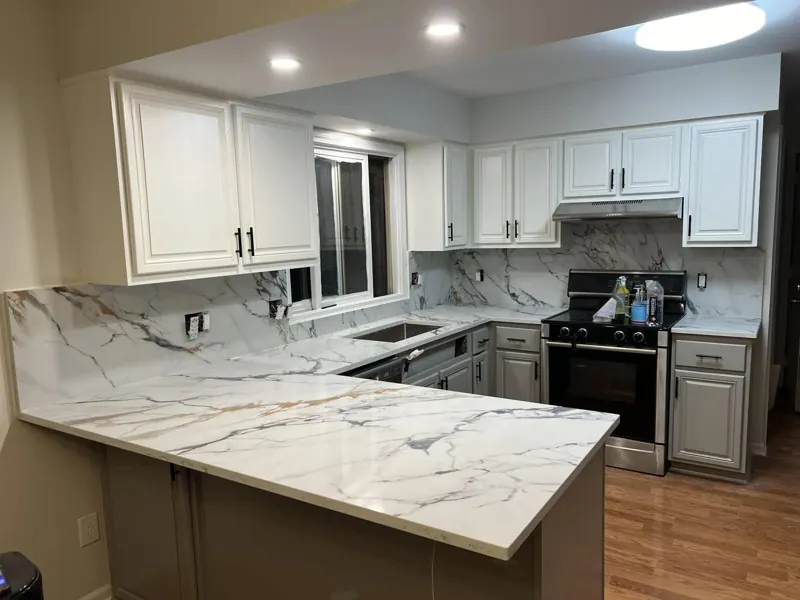

For most Metro Detroit kitchens, the right island countertop is granite, quartz, quartzite or marble, chosen for how you cook, sit and clean. Your island is the surface that takes the most daily use, so pick the stone by how the island will be used, then have it measured by the person who will fabricate it.
We are Stone Proz, an owner-operated shop at 19024 Florida St in Roseville. This guide is the talk we would have with you at your kitchen island, written for homeowners who have never hired a fabricator.
TL;DR
- Quartz and granite earned top scores for spills, hot pots and knives in Consumer Reports’ lab tests, which makes both a solid starting point for a busy island.
- Granite, quartzite and marble need sealing. Quartz is engineered and follows the manufacturer’s care instructions instead.
- Seating decides your overhang (the part of the top that hangs past the island base) and the clearance around the island.
- A large island may need more than one slab, which means a seam. Planning that seam early keeps it where it looks best.
- Your price comes from the in-home measure and written quote, after a free phone consult.
Table of Contents
- Which countertop material is right for a kitchen island?
- How do granite, quartz, quartzite and marble compare on an island?
- Should the island match the rest of your countertops?
- How much overhang and clearance does an island need?
- Will a large island need a seam?
- What does a kitchen island countertop cost?
- How does hiring a fabricator for your island work?
- Why hire an owner-operated shop for your island?
- What else do homeowners ask about island countertops?
- Sources
Which countertop material is right for a kitchen island?
The right material is the one that matches how your family uses the island. If it is the main prep and homework spot, choose a hard, low-fuss surface. If it is mostly for show and a morning coffee, you have more freedom to pick for looks.
We fabricate and install four stones: granite, quartz, quartzite and marble. Each one suits a different kind of island.
Consumer Reports tested 14 countertop materials in its countertop buying guide. Quartz and granite earned top scores for spills, hot pots and knives. The guide describes quartz as ideal for areas that get plenty of use and granite as a good choice for heavily used areas.
That matters for an island, because it is the first place the grocery bags, the cutting board and the kids land.
How do granite, quartz, quartzite and marble compare on an island?
They differ most in how they look, how they are cared for and how they handle acids and hot pans. Here is a plain side-by-side.
| Stone | What it is | Care on an island | Good fit when |
|---|---|---|---|
| Granite | Natural stone cut from a quarry | Needs periodic sealing | You want natural variation and a hard-working surface |
| Quartz | Engineered stone made in a factory | No sealing; follow the manufacturer’s care guide | You want a consistent look and simple cleaning |
| Quartzite | Natural stone, harder than marble | Needs sealing at installation and regular resealing | You want a marble-like look with more toughness |
| Marble | Natural stone prized for its veining | Needs sealing and can etch from acids | You want a classic look and accept it will age |
A few details are worth knowing before you choose.
Granite
Granite is natural, so every slab is different. Consumer Reports notes that granite needs periodic sealing and that its edges can chip, which a professional repairs. Sealing is a quick wipe-on step that protects the stone from stains. Our granite countertop page shows what we fabricate.
Quartz
Quartz is engineered, which means it is manufactured from crushed stone and resin instead of cut whole from the ground. Consumer Reports says it needs no sealing and is waterproof. Because it is engineered, you follow the manufacturer’s specifications for cleaning and for hot pans, and a trivet under a hot pan is a good habit on any island. See our quartz countertops for what is available.
Quartzite
Quartzite is a natural stone, and it is not the same thing as quartz. Martha Stewart’s guide to common countertops describes it as harder and more durable than marble, and as porous, so it is sealed at installation and resealed on a regular schedule. If you want the details, read our article on custom quartzite countertops or visit the quartzite page.
Marble
Marble gives an island a soft, classic look. Designer Mindy O’Connor told Martha Stewart that marble can etch (lose its shine in a dull spot) from acids such as citrus, vinegar, coffee, wine and tomatoes. If you love marble, wipe spills quickly and keep it sealed. Our marble countertops page has more.
Should the island match the rest of your countertops?
It can match or contrast, and both work. A matching island makes the kitchen feel unified. A contrasting island becomes the focal point of the room.
Homes & Gardens recommends matching island and perimeter worktops for a coordinated scheme. It also describes mixed materials as a way to separate zones, such as prep and gathering. The Spruce quotes designer Esther Ellard on a contrasting island as a visual focal point, and gives an example of darker single-tone island quartz paired with lighter, patterned perimeter stone.
Some practical ideas for Metro Detroit kitchens:
- Same stone, same color. The calmest look. It suits smaller kitchens where a second color would feel busy.
- Same stone family, different color. A darker island with lighter perimeter counters adds depth without clashing.
- Two different stones. Quartzite on the island and granite around the walls, for example. Have both samples side by side in your own light before you decide.
- Waterfall edge. Better Homes & Gardens says waterfall edges suit modern kitchens but need more stone and more installation labor. A waterfall is when the stone continues down the side of the island to the floor.
Consumer Reports also points out that you can put the more expensive surface on the prominent island and a less expensive one on the perimeter. That is a sensible way to spend where people look first.
How much overhang and clearance does an island need?
The amount depends on the height of the island. Seating needs knee room, and walking around the island needs breathing room.
Fine Homebuilding reports that the National Kitchen & Bath Association recommends an 18-inch overhang for 30-inch-high counters, 15 inches for 36-inch-high counters and 12 inches for 42-inch-high counters, in its article on how to design a kitchen island. The same article says diners need at least 2 feet of counter space per seat, and that an overhang often needs legs or brackets for support.

That last point is where stone and structure meet. A big overhang with nothing underneath it puts stress on the stone. We talk through supports during the measure so the overhang is planned before the stone is cut.
For walking space, Family Handyman quotes designer Emily LaMarque recommending at least 42 inches of clearance around an island, and 48 inches for more comfortable circulation, in its guide to choosing the right island size. If two people cook at once, lean toward the wider number.
A quick way to test your plan: tape the island outline on your floor, then stand in the clearance with the dishwasher or oven open. If you can still pass, the layout works.
Will a large island need a seam?
Often, yes. Family Handyman notes in that same guide that larger islands may require more than one slab, which introduces seams and adds material cost. A seam is the joint where two pieces of stone meet.
A well-made seam is tight and sits where it is least noticeable, usually away from the main seating and out of the line of sight from the kitchen entrance. Some stones with bold veining need the pattern lined up across the joint.
This is one reason John measures every island himself. Where the seam goes depends on the slab size, the shape of the island and any cutouts, and it is much easier to plan at the measure than to fix afterward.
What does a kitchen island countertop cost?
The price depends on your island, so we do not quote numbers in an article. Your price comes from the in-home measure and the written quote that follows it.
What moves the price is easy to list. Consumer Reports says an estimate should spell out thickness, finish, sink, faucet and cooktop cutouts, edge treatment, backsplash and removal of the old counter. If a quote leaves any of those out, ask about it.
In plain terms, these things shape your price:
- The stone you choose, and how much of it the island needs.
- The size and shape of the island, including any waterfall sides.
- The edge style, such as a simple eased edge or a more detailed profile.
- Cutouts for a sink, faucet or cooktop.
- Seams, which come with larger islands.
- Removal of an old top, if you are replacing one.
NerdWallet’s kitchen island cost article quotes an estimator saying a sink or cooktop costs more when plumbing, gas or electrical connections are not already in place. That work is outside the countertop itself, so plan it with the right tradesperson before the stone is ordered.
For how pricing works on a kitchen replacement, see what sets your kitchen countertop price.
How does hiring a fabricator for your island work?
It starts with a phone call and ends with a finished top, and you are not asked to commit to anything before you have a written price. Here is how our jobs run from start to finish.
- Free phone consult. You tell us about your kitchen, the island and the stone you are leaning toward.
- Free in-home measure. John comes to your home and measures the island himself. This is called templating (measuring to make a cutting pattern). It records the exact shape, overhang and cutout positions, so the stone is cut to fit your island, not a standard size.
- One written price. After the measure you get one written price. It reflects what we saw in your kitchen.
- Fabrication. The stone is cut and finished in the shop to the measurements taken at your home.
- Installation. Most installs take 1 to 2 days once the stone is fabricated. If an old top is coming out, we handle the tear-out (removing the old countertop) as part of the job.
We do not publish a DIY version of the cutting, fabricating or installing steps. Stone is heavy, it can crack, and one wrong cut cannot be undone. That is the work you hire a fabricator for.
If you want to see the installation day in more detail, read what happens, step by step and what to expect from a Roseville kitchen installation.
Why hire an owner-operated shop for your island?
You deal with the same person from the first measure to the last install. John owns Stone Proz and has more than 20 years of experience installing stone. He measures every job himself, and the owner oversees each project.
That matters on an island because it is the most visible surface in the room. Overhang, seams, edges and cutouts all show, and a measure done by the person who answers for the result tends to catch what a rushed one misses.
We work on kitchen countertops, bathroom vanity tops and countertop replacement, in granite, quartz, quartzite and marble. We do stone countertops only, so that is where our attention goes.
If you want to see the kind of work we do before you call, browse our project gallery. When you are ready, our kitchen countertops page explains how to start a free estimate.
We serve Roseville and nearby Macomb County cities, plus Harper Woods and the Grosse Pointes.
What else do homeowners ask about island countertops?
Can I use a different stone on my island than on my perimeter counters?
Yes. Many homeowners do, either to make the island stand out or to spend more on the surface everyone sees first. Consumer Reports suggests the more expensive material on the island and a less expensive one on the perimeter. Look at both samples together in your own kitchen light before you decide.
Do natural stone sealing rules apply to quartz?
No. Sealing applies to granite, quartzite and marble, which are natural stones. Quartz is engineered and follows the manufacturer’s specifications for care and use. We go over the right care for your stone when we install it.
Can you remove my old island top?
Yes. We do countertop replacement, including tear-out of old countertops. Tell us about it on the phone consult so it is part of your written price. Our countertop replacement page has the details.
Do you cut for a sink or cooktop in an island?
Yes, we make sink and faucet cutouts as part of the fabrication, and John records their positions at the in-home measure. If you are adding a sink or cooktop where there was none, plan the plumbing, gas or electrical work first, since the stone has to be cut to match.
Ready to plan your island? Call us at (586) 718-8092 or request a free estimate, and we will set up your free in-home measure.
Sources
- Best Countertop Buying Guide, Consumer Reports
- The Most Popular Kitchen Countertop Materials, Martha Stewart
- What to Know About Adding a Kitchen Island to Your Home, Martha Stewart
- Island Countertop Ideas, Homes & Gardens
- Can Kitchen Islands Have a Different Countertop, The Spruce
- Kitchen Island Ideas, Better Homes & Gardens
- How to Design a Kitchen Island, Fine Homebuilding
- Is Your Kitchen Island Too Big, Family Handyman
- Kitchen Island: Costs and Ways to Save, NerdWallet